
02 Apr Chapter 8. Removing Our Hindrances
And Forgive Us Our Trespasses | Meaning
We’ve just described our journey toward a life in Christ as a rising. But the act of “rising” (such as rising above petty arguments and concerns) can sometimes get us into trouble. The reason is that when we rise toward our divinity, we often look down on others with a misguided sense of superiority.1 Jesus condones none of that. He knocks us off our pedestals by insisting that we wash the feet of others if we are to have any part of him.2
To keep us grounded Jesus also teaches that our rebirth in Christ is owed to both spirit and water.3 This lesson is one that’s largely been forgotten. Most Christians today see water simply as an accoutrement to the ritual of baptism, forgetting that the performance of rituals was something that Jesus only grudgingly accepted—for he knew how often they become codified into new forms of idolatry.
We can see such idolatry in the way the Pharisees rigidly held to their laws of the Sabbath.4 When it came to baptism, Jesus saw it as something which needed to be done for the sake of the community, rather than for himself—telling John the Baptist they must suffer the task so as to “satisfy every claim of religion.”5 In other words, Jesus allowed himself to be baptized to fulfill the religious expectations of Israel, so that their minds would remain open to receiving the gospel of Christ.
That the heavens are said to have literally opened up during Jesus’s baptism, with the Holy Spirit descending on his head like a dove,6 does not mean that we are magically turned into Christians during this ritual. Instead, these metaphors are used to illustrate water’s essential role in our spiritual transformation.
To understand why Jesus says that our rebirth in Christ is owed to water, we must look at water as a parable, or character in a story. Water’s narrative is that it likes to follow the path of least resistance. Likewise, the Holy Spirit seeks the path of least resistance as we remove the hindrances7 that block Christ from entering our lives.
Throughout Christendom this teaching has been driven under ground by a litany of ignoble wars, fire and brimstone preachers, and overzealous missionaries. But no person has ever been led to Christ through violence, threats, or intimidation, only by experiencing the Holy Spirit as it flows effortlessly from the souls of others.
Listen to the Full Audiobook
Jesus & The Parable of Water
How easily we forget Jesus’s admonition to turn the other cheek; to not resist wrongs; to give our possessions to those who want to sue us; and walk two miles with those who compel us to go but one.8 In other words, to pass through this life like water.
Rather than accept the path of least resistance, we often strike out on the course of greatest resistance, confusing the lesser path with one of weakness. What we fail to recognize (but what Jesus was well aware of) is that water has another defining characteristic. It has the dammed up potential to flow forward with great force when its hindrances are pulled away, forever altering the landscape below the break. Likewise, the Holy Spirit has tremendous power to transform lives, to create a holy current that will carry along others and make us true fishers of men,9 if we but remove the obstacles in its path.
When we pray “forgive us our trespasses” we are beginning this process of removal. But instead of involving heavy lifting, this process is simply one of letting go” of release.10 By seeking the Father’s forgiveness—which is ours for the asking11 — we cannot change the past, but we can alter the living hour by letting go of the guilt, the feelings of inadequacy, and the shame.
When Jesus says that we should cut off our hands or pluck out our eyes if they offend us,12 he is striking at the root behavior (the “snares”) that give rise to these feelings of worthlessness, which keep us tied to the fiery pit of our egos, and prevent us from entering the stream of the Holy Spirit which flows eternally in the kingdom of heaven.
By seeking forgiveness for “our trespasses” we also acknowledge an important truth about our “daily bread.” That is, the ownership we have claimed over it is a joint one shared with every man, woman, and child. This partnership is so entwining that, try as we might, we will always trespass on the feelings and interests of others — and often in ways we are not even conscious of at the time.
The story of Lazarus13 illustrates how we often go through life unaware of how our actions affect others. Lazarus, like the prodigal son,14 is not literally “dead.” He is only asleep to the divinity within himself and others. Jesus’s waking of Lazarus is a parable that calls us all to wakefulness,15 as we remove the hindrances (or “snares”) that block our rebirth in Christ.
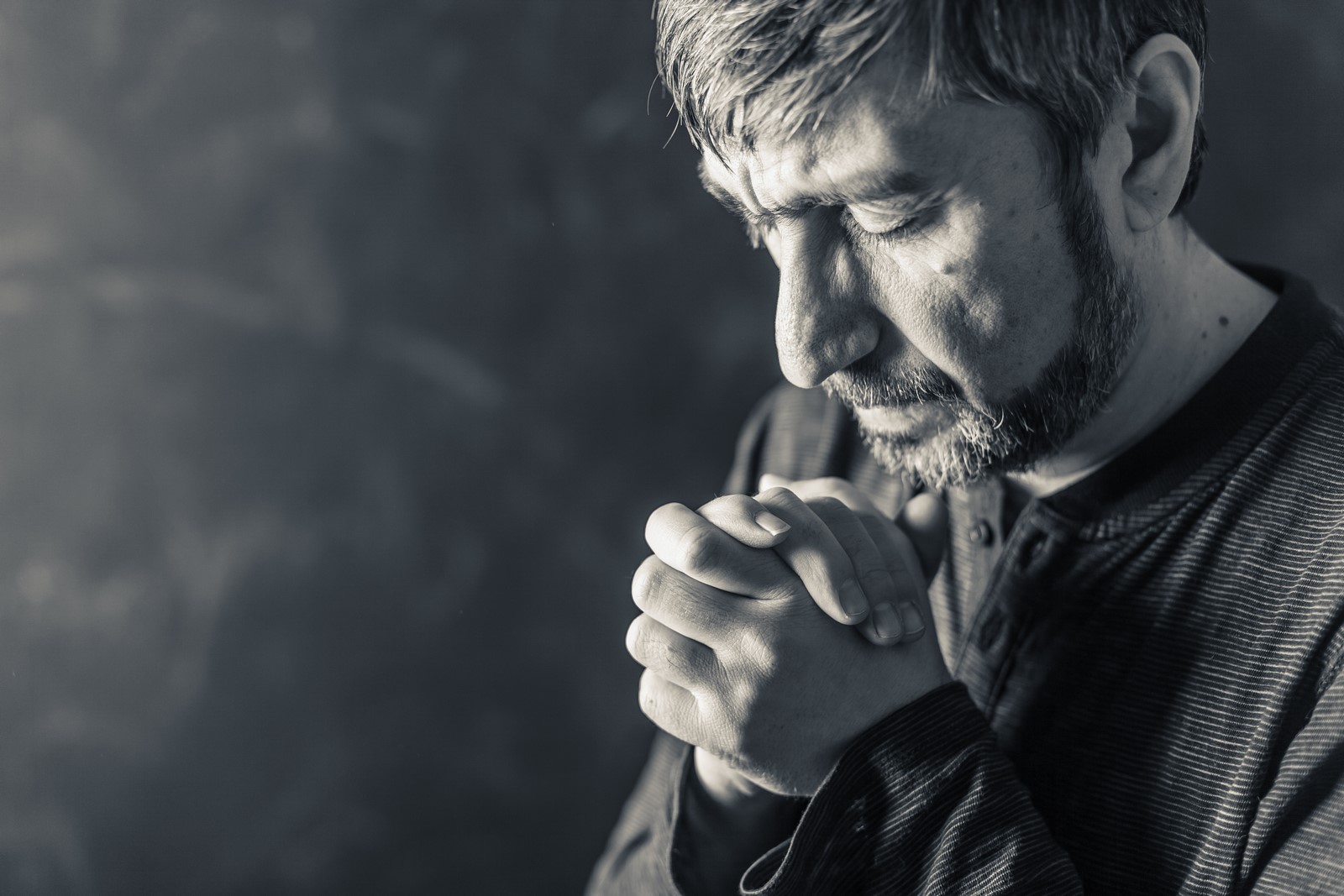
The fact that we cannot escape our trespasses is why it is so important that we pray The Lord’s Prayer every day. For by doing so we clean the slate and re-enter the living hour with a fresh start. Consider again the life of Jesus. If there is one thing we can say for sure, it is that he was a person who prayed hard and prayed a lot.16 This shows that as we get closer to a life in Christ our need for the Lord’s Prayer does not decrease but increases.
We might, at first, think this strange. After all, doesn’t our need for forgiveness diminish as we grow closer to God? The answer is yes and no. On the one hand, our trespasses do diminish. But as our Christ consciousness expands, we begin to recognize all those daily offenses to which we once were blinded. Not to mention the trespasses of others for which we now start sharing greater responsibility, and is the subject of our next chapter.
Read Chapter 9: As We Forgive Those Who Trespass Against Us Meaning (Removing Our Hindrances Part II)
- Speaking to people who were satisfied that they were religious, and who regarded everyone else with scorn, Jesus told this parable. — Luke 18:9 [↩]
- If I, then—”the Master’ and “the Teacher’—have washed your feet, you also ought to wash one another’s feet; 15 For I have given you an example, so that you may do just as I have done to you. — John 13:14-15 [↩]
- “In truth I tell you,” answered Jesus, “unless you owe your birth to water and spirit, you cannot enter the kingdom of God. — John 3:5 [↩]
- Jesus walked through the corn-fields one Sabbath. His disciples were hungry, and began to pick some ears of wheat and eat them. 2 But, when the Pharisees saw this, they said: “Look! your disciples are doing what it is not allowable to do on a Sabbath!” 3 “Have not you read,” replied Jesus, “what David did, when he and his companions were hungry. 4 How he went into the house of God, and how they ate the consecrated bread, though it was not allowable for him or his companions to eat, but only for the priests? 5 And have not you read in the law that, on the Sabbath, the priests in the temple break the Sabbath and yet are not guilty? 6 Here, however, I tell you, there is something greater than the temple! 7 And had you learned the meaning of the words: “I desire mercy, and not sacrifice,’ you would not have condemned those who are not guilty. 8 For the Son of Man is Lord of the Sabbath.” Matthew 12:1—8 [↩]
- Jesus came from Galilee to the Jordan to see John and be baptized by him. 14 But John tried to prevent him. “It is I,” he said, “who need to be baptized by you; and yet you come to me?” 15 “Suffer it be so for the present,” Jesus answered, “since it is fitting for us thus to satisfy every claim of religion.” Matthew 3:13-15 [↩]
- Jesus came from Nazareth in Galilee, and was baptized by John in the Jordan. 10 And just as he was coming up out of the water, he saw the heavens rent apart, and the Spirit, like a dove, descending upon him. — Mark 1:9-10 [↩]
- Blessed are those who find no hindrance in me. — Luke 7:23 [↩]
- I, however, say to you that you must not resist wrongs; but, if others should strike you on the right cheek, turn the other to them also; 40 And, when people want to go to law with you to take your coat, let them have your cloak as well; 41 And, if anyone compels you to go one mile, go two miles with them. — Matthew 5:39—41 [↩]
- As Jesus was walking along the shore of the Sea of Galilee, he saw two brothers—Simon, also known as Peter, and his brother Andrew—casting a net into the sea; for they were fishermen. 19 “Come and follow me,” Jesus said, “and I will make you fishers of men.” 20 The two men left their nets at once and followed him. — Matthew 4:18-20 [↩]
- “For, I tell you, if your faith were only like a mustard-seed, you could say to this mountain “Move from this place to that!’ and it would be moved; and nothing would be impossible to you; 21 For these things are released only by prayer and fasting.” Matthew 17:20-21 [↩]
- I say to you: “Have faith that whatever you ask for in prayer is already granted you, and you will find that it will be.’ — Mark 11:24 [↩]
- If your hand proves a snare to you, cut it off. It would be better for you to enter the life maimed, than to have both your hands and go into the pit, into the inextinguishable fire: 44 Where the worm dies not, and the fire is not quenched.” 45 “If your foot proves a snare to you, cut it off. It would be better for you to enter the Life lame, than to have both your feet and be thrown into the pit: 46 Where the worm dies not, and the fire is not quenched. 47 If your eye proves a snare to you, tear it out. Mark 9:43—47 [↩]
- Jesus called in a loud voice: “Lazarus! come out!” 44 The dead man came out, wrapped hand and foot in a winding- sheet; his face, too, had been wrapped in a cloth. “Set him free,” said Jesus, “and let him go.” John 11:43-44 [↩]
- “Child,’ the father answered, “you are always with me, and everything that I have is yours. 32 How could we do anything else but make merry and rejoice, for here is your brother who was dead, and is alive; who was lost, and is found.’ — Luke 15:32 [↩]
- Therefore watch, for you cannot be sure when the Master of the house is coming—whether in the evening, at midnight, at daybreak, or in the morning, 36 Else he should come suddenly and find you asleep. 37 And what I say to you I say to all: watch!” Mark 13:35—37 [↩]
- The story about Jesus spread all the more, and great crowds came together to listen to him, and to be cured of their illnesses; 16 But Jesus used to withdraw to lonely places and pray. — Luke 5:15—16 [↩]