Thomas Paine on Christianity & True Greatness

July 20, 2009 by  
Filed under Progressive Christianity


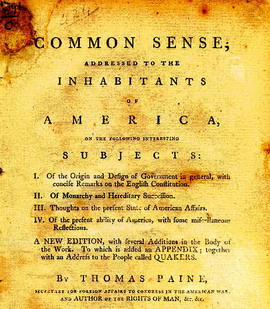
thomas paine christianity Thomas Paine on Christianity & True Greatness This week in our special series on the Founding Fathers, we begin with the revolutionary Thomas Paine, a statesman who often was ostracized for his SBNR (Spiritual But Not Religious) views on Christianity, God, and religion. Like a true Progressive Christian, Paine tried to encourage forward progress in all aspects of the individual life and the life of the nation. His work The Rights of Man remains a testament to his enlightened perspective on the nature of public rights versus those of a government, while his famous pamphlet Common Sense reminds us still today, to our chagrin, how uncommon “common sense” truly is.

The following passage comes from “To The People of England” included in The Writings of Thomas Paine, Volume I. Here we find Paine discussing one of his favorite topics, national honor, from the simple perspective of common decency. As is so often the case with the writings of the Founding Fathers, Paine’s commentary remains as relevant today as when it was written>

There is an idea that exists in the world known as national honor, and this, falsely understood, is often times the cause of war. In a Christian and philosophical sense, mankind seems to have stood still at individual civilization, and to retain as nations all the original rudeness of nature. Peace by treaty is only a cessation of violence for a reformation of sentiment. It is a substitute for a principle that is wanting and ever will be wanting till the idea of national honor be rightly understood. As individuals we profess ourselves Christians, but as nations we are heathens, Romans, and what not.

I remember the late admiral Saunders declaring in the House of Commons, and that in the time of peace, “That the city of Madrid laid to ashes was not a sufficient atonement for the Spaniards taking off the rudder of an English sloop of war.” I do not ask whether this is Christianity or morality, I ask whether it is decency? Whether it is proper language for a nation to use? In private life we call it by the plain name of bullying, and the elevation of rank cannot alter its character. It is, I think, exceedingly easy to define what ought to be understood by national honor, and that is this:

What is the best character for an individual is the best character for a nation; and wherever the latter exceeds or falls beneath the former, there is a departure from the line of true greatness.1

Read the next article in our series on the Founding Fathers: Patrick Henry & The Christian Divide.

Gain fresh insight
into the Lord’s Prayer. Read our free online book The Lord’s Prayer for Daily Life. The prayer’s hidden teachings will enrich and inspire you. Click the following link to begin reading the Living Hour book now: The Lord’s Prayer.

  1. Some small edits were made in the above passage from Thomas Paine to make it easier to read by modern readers. []

Benjamin Franklin’s Religion & Jesus of Nazareth

July 15, 2009 by  
Filed under Progressive Christianity

benjamin franklin religion Benjamin Franklins Religion & Jesus of Nazareth Continuing with The Living Hour’s month-long series on the Founding Fathers’ reflections on God, Christianity, and Religion, we move today to some commentary from that SBNR Progressive Christian Benjamin Franklin. The following passage is taken from a letter Franklin wrote to the reverend Ezra Stile in 1790, when Franklin was 84 years old, and Stile was serving as president of Yale College. Here we find Franklin discussing his perspectives on religion and the significance of Jesus of Nazareth.

Considering Franklin is 84, it is especially interesting to note his statement that this is the first time he has been questioned about his religious beliefs. True to form, Ben Franklin’s answers reveal the reasonable common sense approach that the candle-maker’s son took towards life, as well as the calm and good-natured temperament for which he was well-known.

This correspondence is probably the most definitive one we have on Benjamin Franklin’s religion. His “creed” is certainly one worth emulating.

You desire to know something of my religion. It is the first time I have been questioned upon it. But I do not take your curiosity the wrong way, and will try in a few words to gratify it. Here is my creed: I believe in one God, creator of the universe; that He governs it by his providence; that He ought to be worshipped; that the most acceptable service we can render Him is to do good to his other Children. And that the Soul of Man is immortal, and will be treated with justice in another life respecting its conduct in this.

These I take to be the fundamental principles of all sound religions, and I admire them, as you do, in whatever sect I meet them. As to Jesus of Nazareth, my opinion of whom you particularly desire, I think the system of morals and his religion, as he left them to us, to be the best the world has ever seen, or is likely to see. But I believe it has received various corrupting changes, and I am in accord with the present dissenters in England in having some doubts regarding Jesus’s divinity: although it is a question I do not dogmatize upon, having never studied it, and think it needless to busy myself with it now, when I expect soon the opportunity of knowing the truth with less trouble.

I see no harm however in it being believed, if that belief has the good consequence, as probably it has, of making his doctrines more respected and better observed. I shall only add respecting myself that having experienced the Goodness of that Being in conducting me prosperously through a long Life, I have no doubt of its continuance in the next, even though I hold not the smallest conceit of meriting such Goodness.1

Read the next article in our series on the Founding Fathers: John Dickinson, Divine Providence & Our Freedoms

Gain fresh insight into the Lord’s Prayer. Read our free online book The Lord’s Prayer for Daily Life. The prayer’s hidden teachings will enrich and inspire you. Click the following link to begin reading the Living Hour book now: The Lord’s Prayer.

  1. Some very small edits were made to the above passage to make it more easily read by the modern reader. []