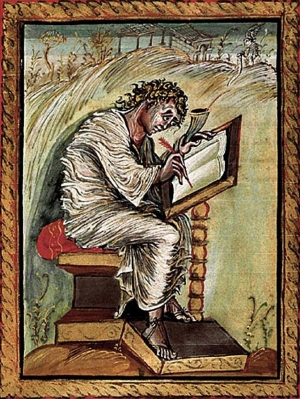
Dead Bury Their Dead

August 4, 2011 by  
Filed under Gospel of Matthew


matt2 Dead Bury Their Dead

Gospel of Matthew 8

When Jesus had come down from the hill, great crowds followed him. 2 And he saw a leper who came up, and bowed to the ground before him, and said: “Master, if only you are willing, you are able to make me clean.” 3 Stretching out his hand, Jesus touched him, saying as he did so: “I am willing; become clean.” Instantly he was made clean from his leprosy; 4 And then Jesus said to him: “Be careful not to say a word to anyone, but go and show yourself to the priest, and offer the gift directed by Moses, as evidence of your cure.”

5 After Jesus had entered Capernaum, a captain in the Roman army came up to him, entreating his help. 6 “Sir,” he said, “my servant is lying ill at my house with a stroke of paralysis, and is suffering terribly.” 7 “I will come and cure him,” answered Jesus. 8 “Sir,” the captain went on, “I am unworthy to receive you under my roof; but only speak, and my manservant will be cured. 9 For I myself am a man under the orders of others, with soldiers under me; and, if I say to one of them ‘Go,’ he goes, and to another ‘Come,’ he comes, and to my slave ‘Do this,’ he does it.”

10 Jesus was surprised to hear this, and said to those who were following him: “Never, I tell you, in any Israelite have I met with such faith as this! 11 Yes, and many will come in from East and West and take their places beside Abraham, Isaac, and Jacob, in the kingdom of heaven; 12 While the heirs to the kingdom will be ‘banished into the darkness’ outside; there, there will be weeping and grinding of teeth.” 13 Then Jesus said to the captain: “Go now, and it shall be according to your faith.” And the man was cured that very hour.

14 When Jesus went into Peter’s house, he saw Peter’s mother–in–law prostrated with fever. 15 On his taking her hand, the fever left her, and she rose and began to wait upon him. 16 In the evening the people brought to Jesus many who were possessed by demons; and he drove out the spirits with a word, And cured all who were ill, 17 In fulfillment of these words of the prophet Isaiah: ‘He took our infirmities on himself, and bore the burden of our diseases.’

——–

What is the Lord’s Prayer?

——–

18 Seeing a crowd round him, Jesus gave orders to go across. 19 And a teacher of the law came up to him, and said: “Teacher, I will follow you wherever you go.” 20 “Foxes have holes,” answered Jesus, “and wild birds their roosting–places, but the Son of Man has nowhere to lay his head.” 21 “Master,” said another, who was a disciple, “let me first go and bury my father.” 22 But Jesus answered: “Follow me, and let the dead bury their dead.”

23 Then he got into the boat, followed by his disciples. 24 Suddenly so great a storm came upon the sea that the waves broke right over the boat. But Jesus was asleep; 25 And the disciples came and roused him. “Master,” they cried, “save us; we are lost!” 26 “Why are you so timid?” he said. “O ye of little faith!” Then Jesus rose and rebuked the winds and the sea, and a great calm followed. 27 The men were amazed, and exclaimed: “What kind of man is this, that even the winds and the sea obey him!”

28 And on getting to the other side—the country of the Gadarenes—Jesus met two men who were possessed by demons, coming out of the tombs. They were so violent that no one was able to pass that way. 29 Suddenly they shrieked out: “What do you want with us, Son of God? Have you come here to torment us before our time?”

30 A long way off, there was a drove of many pigs, feeding; 31 And the foul spirits began begging Jesus: “If you drive us out, send us into the drove of pigs.” 32 “Go,” he said. The spirits came out, and entered the pigs; and the whole drove rushed down the steep slope into the sea, and died in the water. 33 At this the men who tended them ran away and went to the town, carrying the news of all that had occurred, and of what had happened to the possessed men. 34 At the news the whole town went out to meet Jesus, and, when they saw him, they entreated him to go away from their neighborhood.

—–

To read Chapter 8 of the Gospel of Matthew, please go to: Sheep Among Wolves

Gain fresh insight into the Lord’s Prayer. Read our free online book The Lord’s Prayer for Daily Life. The prayer’s hidden teachings will enrich and inspire you. Click the following link to begin reading the Living Hour Book now: The Lord’s Prayer.

Browse the entire Gospel of Matthew here: Gospel of Matthew

Lord’s Prayer: Give Us This Day

July 18, 2011 by  
Filed under Lord's Prayer

the lords prayer day Lords Prayer: Give Us This Day

Chapter 6

Give us this day…

(Gathering the Moment at Hand)

Up to this point in the Lord’s Prayer, Jesus has been laying a foundation—one that establishes our relationship to God and his creation. When we recite the beginning of the prayer, we are thus engaging in an act of grounding, reminding ourselves that at the core of our existence we remain rooted in Christ.1

With the foundation complete, Jesus moves on to what many of us think is the business of prayer: asking for things. But as we mentioned in Chapter 2, prayer isn’t about asking for special favors. In fact, it isn’t even about “asking” at all—since, as Jesus says, God already knows what we need before we ask him.2 So what is prayer about? The simplest answer is that it is about gathering and release.

When we think about gathering and Christ, the first image that comes to mind is probably the shepherd. Many of us see Jesus as the “Good Shepherd”3 gathering his lost flock back within the fold of his love. This image is popular because Jesus often used sheep and shepherds as metaphors when he taught. He described those who deliver the gospel of Christ as lambs among wolves,4 and those without Christ’s guidance as sheep without a shepherd.5 He also warned us of embracing false teachers who come in the guise of innocent sheep but have sinister hidden agendas.6

What we don’t usually think about when contemplating gathering is the story of the prodigal son. We talked earlier about how this parable reveals the will of God as a matter of choice. But when we turn our attention to the son, and view the story through his eyes, the parable reveals a different lesson—which is the wonderful thing about parables: like crystals, they reflect new light (insight) as we turn them.

When the young man seeks his inheritance from his father, he doesn’t plead for it. Instead, he speaks with authority: “Father, give me my share of the inheritance.” (A man had two sons; 12 And the younger of them said to his father: ‘Father, give me my share of the inheritance.’ So the father divided the property between them. – Luke 15:11-12)) We often overlook that fact. But it is an important one. Because it shows that the son is claiming ownership over something that he believes is rightfully his.

Throughout the Gospels, Jesus also speaks with “authority”,7 and says that when we speak in such a way, our Father will dutifully respond. In fact, he claims that God will grant us anything:8 that the dead will rise,9 and mountains move at our command, if we but have the faith of a mustard–seed10 and command it in his name.

This teaching has caused a lot of confusion over the years. Some Christians have taken it at face value and, because of that, acted irresponsibly—such as recklessly barring medical treatment to loved ones (believing that they could heal them through faith alone). Others have disregarded the whole moving mountains thing as just Jesus getting a little carried away with his metaphors. But if we reflect on the teaching a little longer, the true Word begins to emerge.

Let’s begin our reflections by recalling that…

The Lord’s Prayer. To continue reading, click on page 2 at the bottom.

  1. By the seed which was sown on the good ground is meant the receivers who hear the message and understand it, yielding a return, sometimes one hundred, sometimes sixty, sometimes thirty fold. – Matthew 13:23 []
  2. When praying, do not repeat the same words over and over again, as is done by the Gentiles, who think that by using many words they will obtain a hearing. 8 Do not imitate them; for God, your Father, knows what you need before you ask him. – Matthew 6:7-8 []
  3. I am the good shepherd; and I know my sheep, and my sheep know me. – John 10:14 []
  4. Now, go. Remember, I am sending you out as my messengers like lambs among wolves. – Luke 10:3 []
  5. On getting out of the boat, Jesus saw a great crowd, and his heart was moved at the sight of them, because they were ‘like sheep without a shepherd’. – Mark 6:34 []
  6. Beware of false teachers: those who come to you in the guise of sheep, but at heart they are ravenous wolves. – Matthew 7:15 []
  7. On the next Sabbath, Jesus went into the synagogue and began to teach. 22 The people were amazed at his teaching, for he taught them like one who had authority, and not like the teachers of the law. – Mark 1:21-22 []
  8. Whatever you ask for in your prayers will, if you have faith, be granted you.” Matthew 21:22 []
  9. Even now, I know that God will grant you whatever you ask him.” 23 “Your brother shall rise to life,” said Jesus. – John 11:23 []
  10. “For, I tell you, if your faith were only like a mustard-seed, you could say to this mountain ‘Move from this place to that!’ and it would be moved; and nothing would be impossible to you. – Matthew 17:20 []

Lord’s Prayer: The Kingdom, The Power, & The Glory

July 12, 2011 by  
Filed under Lord's Prayer

lords prayer power glory Lord’s Prayer: The Kingdom, The Power, & The Glory

Chapter 12

For thine is the

kingdom, the power, and

the glory, forever, amen.

(Understanding God Time)

The Lord’s Prayer began by grounding us in our relationship with the Father, and it ends now by solidifying our faith in that kinship. We have already talked about how the kingdom, power, and the glory of God are played out within the living hour; but most of us are not satisfied with this daily bread. We want to know that there is a divine plan, with a definitive beginning and end, that’s been arranged by the Father.

Our desire to see the culmination of God’s plan is what led Jesus’s early Jewish followers to believe that he was an earthly messiah. And it is what fuels today such false beliefs as the rapture and Jesus’s second-coming out of the clouds. Without an end–game in place, we find our faith under assault,1 as we try to make sense of a world filled with horrors, suffering, and loss. Yet it is precisely this lack of knowledge in God’s final act (like our uncertainty in what happens to us after we die) that creates the condition which rewards those with the faith of but a mustard seed.

If we are to acquire that life giving faith, and get glimpses of the Father’s divine plan, we must take a “big picture” view of our lives and the history of the world. This means letting go of human time and entering God time. With human time we focus on beginnings and ends, and see time as a product that can be saved, lost, and spent. And we view morality within the limits of those human constraints. But with God time we are dealing with a cyclical ebb and flow that cannot be pinned down—and where moral reckoning occurs on a timeline that far exceeds an individual lifetime.

Our life in Christ is beyond beginnings and ends—which is why Jesus says that he existed before Abraham2 and his words will live on even after heaven and earth pass away.3 The Holy Spirit constantly is in the process of rising and receding. This means that the crucifixion of our ego is not a one time affair. We are called to repeatedly lay down our lives,4 as we rise ever closer toward our divinity.

Jesus imparts this teaching of recurring crucifixion when he tells us that we must pick up our crosses daily.5 And our repeated rise toward Christ is demonstrated in the gospel story by Jesus’s reappearance within the form of a person that his disciples do not recognize.6 When, during the course of our spiritual evolution, we shed our egos, even those closest to us often fail to recognize the new person we’ve become. The fact that Jesus chooses to crucify his ego yet again, having already risen in Christ and been able to teach the gospel, demonstrates that no matter how high we’ve risen the ego continually builds new obstacles that need to be overcome.

When we pray For thine is the kingdom, the power, and the glory, forever, amen, we are thus confirming our faith in today’s living Christ;7 as well as God’s divine plan that we, his children, can feel only intimations of but never fully know.8 As the 19th century Unitarian Minister Theodore Parker once said: “I do not pretend to understand the moral universe, the arc is a long one, my eye reaches but little ways. I can calculate the curve and complete the figure by the experience of sight; I can divine it by conscience. But from what I see, I am sure it bends toward justice.”

You have been reading Chapter 12 from the book The Living Hour: The Lord’s Prayer for Daily Life (with New Testament Gospels). This faith book on life and the power of the The Lord’s Prayer is available for purchase in trade paperback below.

If you appreciate the work of LivingHour.org, please support us today by linking to our website. We also welcome your financial support. You can make your secure online donation via PayPal by clicking the following icon:

pixel Lord’s Prayer: The Kingdom, The Power, & The Glory


Buy the Trade Paperback for $15.99

x click butcc Lord’s Prayer: The Kingdom, The Power, & The Glory

  1. A violent squall came on, and the waves kept crashing into the boat, so that the boat was actually filling. 38 Jesus was in the stern asleep upon the cushion; and the disciples roused him and cried: “Teacher! Is it nothing to you that we are lost?” – Mark 4:37–38 []
  2. “You are not fifty years old yet,” the Jews exclaimed, “and have you seen Abraham?” 58 “In truth I tell you,” replied Jesus, “before Abraham was, I am.” – John 8:57–58 []
  3. I tell you that even the present generation will not pass away till all has taken place. 33 Heaven and earth will pass away, but my words will never pass away. – Luke 21:33 []
  4. This is why the Father loves me, because I lay down my life—to receive it again. 18 No one took it from me, but I lay it down of myself. I have authority to lay it down, and I have authority to receive it again. John 10:17–18 []
  5. “If anyone wishes to walk in my steps, let them renounce self, and take up their cross daily, and follow me. – Luke 9:23 []
  6. After saying this, she turned round and looked at Jesus standing there, but she did not know that it was Jesus. 15 “Why are you weeping? Whom are you seeking?” he asked. Supposing him to be the gardener, Mary answered: “If it was you, sir, who carried him away, tell me where you have laid him, and I will take him away myself.” – John 20:14–15 []
  7. They could not find the body of the Lord Jesus. 4 While they were at a loss to account for this, all at once two men stood beside them, in dazzling clothing. 5 But, when in their fear the women bowed their faces to the ground, the men said to them: “Why are you looking among the dead for him who is living?” Luke 24:3-5 []
  8. The heavens and the earth will pass away, but my words shall never pass away. But about that day and hour, no one knows: not even the angels of heaven, nor yet the Son, but only the Father himself. Matthew 24:36 []

Jesus, Buddha, & Grammatolatry at St. Mary’s Brisbane

March 8, 2010 by  
Filed under Progressive Christianity

grammatolatry owen Jesus, Buddha, & Grammatolatry at St. Marys Brisbane After talking about the Buddhist statue controversy at St. Mary’s South Brisbane, we were reminded of just how many similar teachings and attitudes exist between Jesus and Buddha. One of the most prominent behaviors which these two prophets share is that neither one wrote anything down. By today’s standards (where everyone seems to be writing about every triviality under the sun, and then sharing it with millions of online strangers) the idea of possessing profound wisdom but then not writing it down sounds absurd.

Why in the world did Buddha and Jesus do that? After all, it certainly would have solved a lot of headaches and conflicts had they just put their thoughts down on paper (ok, parchment).

If we return to consider the “Buddha” incident at St. Mary’s, an answer to this conundrum actually emerges. As we mentioned in our earlier post, some Christians (including a few St. Mary’s parishioners) mistakenly confused the placement of Buddhist statue with idol worship. Idol worship is something that greatly concerned Jesus and Buddha.1

Not so much the worship of golden calves or physical idols, but the far more insidious idolatry of the written word–because when words become canonized, codified, and literalized they quickly lose their transcendent, life-transforming, power. The living Word becomes dead letter scripture, which now petrified can be used to bludgeon all those who disagree.

During the 1870s, the American social reformer Robert Dale Owen eloquently stated that: “The worship of words is more pernicious than the worship of images. Grammatolatry is the worst species of idolatry. We have arrived at an era in which literalism is destroying faith “The letter killeth.”

If we were only arriving at Christianity’s destructive era in Owen’s time, then today we certainly have reached its denouement. The question that remains is whether or not from these ashes a new, brighter, Phoenix of faith will rise for Progressive Christians. If the goings-on at St. Mary’s South Brisbane are any indication, there is some reason for hope.

—-

Gain fresh insight into the Lord’s Prayer. Read our free online book The Lord’s Prayer for Daily Life. The prayer’s hidden teachings will enrich and inspire you. Click the following link to begin reading the Living Hour book now: The Lord’s Prayer.

  1. Do not believe in anything because it is rumored and spoken of by many; do not think it is proof of its truth. Do not believe merely because the written statement of some old sage is produced; do not be sure that the writing has never been revised by the sage, or can be relied on – Buddha – Wheel of the Law []

Ethan Allen on God, Reason, Prayer, & Religion

August 13, 2009 by  
Filed under Progressive Christianity

ethan allen religion Ethan Allen on God, Reason, Prayer, & ReligionIn this final installment of our special series on the Founding Fathers and their thoughts on God, Religion, & the Divine, we move to farmer, politician, and guerilla revolutionary leader Ethan Allen, who perhaps is best known for leading the Green Mountain Boys (and other fighters) in their raid and capture Fort Ticonderoga, a strategic victory which severely hampered communication between the northern and southern units of the British army.

Like Thomas Jefferson and Benjamin Franklin, Ethan Allen might be best described as a Progressive Christian Deist who believed reason must take a paramount place in religious activity. The following passage is taken from Section IV of Ethan Allen’s book, Reason: The Only Oracle of Man (1784), and deals with the subject of prayer. In synch with the philosophy of prayer that guides our free book The Living Hour: The Lord’s Prayer for Daily, Allen writes:

Whoever has a just sense of the absolute perfection of God, and of their own imperfection, and natural subjection to his providence, cannot but from thence infer the impropriety of praying or supplicating to God, for this, that, or the other thing; or of remonstrating against his providence: inasmuch, as “known to God are all our wants;” and as we know, that we ourselves are inadequate judges of what would be best for us, all things considered.

To pray for any thing, which we can obtain by the due application of our natural powers, and neglect the means of procuring it, is impertinence and laziness in the abstract; and to pray for that which God in the course of his providence, has put out of our power to obtain, is only murmuring against God, and finding fault with his providence, or acting the inconsiderate part of a child; for example, to pray for more wisdom, understanding, grace or faith; for a more robust constitution, handsomer figure, or more of a gigantic size, would be the same as tolling God, that we are dissatisfied with our inferiority in the order of being; that neither our souls nor bodies suit us; that he has been too sparing of his beneficence; that we want more wisdom, and organs better fitted for show, agility and superiority.

But we ought to consider, that “we cannot add one Cubit to our stature,” or alter the construction of our organic frame; and that our mental talents are finite; and that in a vast variety of proportions and disproportions, as our Heavenly Father in his order of nature, and scale of being saw fit; who has nevertheless for the encouragement of intelligent nature ordained, that it shall be capable of improvement, and consequently of enlargement; therefore, “whosoever lacketh wisdom,” instead of “asking it of God,” let him improve what he has, that he may enlarge the original stock; this is all the possible way of gaining in wisdom and knowledge, a competency of which will regulate our faith. But it is too common for great faith and little knowledge to unite in the same person; such persons are beyond the reach of argument and their faith immovable, though it cannot remove mountains.

The only way to procure food, raiment, or the necessaries or conveniences of life, is by natural means; we do not get them by wishing or praying for, but by actual exertion; and the only way to obtain virtue or morality is to practice and habituate ourselves to it, and not to pray to God for it: he has naturally furnished us with talents or faculties suitable for the exercise and enjoyment of religion, and it is our business to improve them aright, or we must suffer the consequences of it. We should conform ourselves to reason, the path of mortal rectitude, and in so doing, we cannot fail of recommending ourselves to God, and to our own consciences. This is all the religion which reason knows or can ever approve of.

Gain fresh insight into the Lord’s Prayer. Read our free online book The Lord’s Prayer for Daily Life. The prayer’s hidden teachings will enrich and inspire you. Click the following link to begin reading the Living Hour book now: The Lord’s Prayer.

If you appreciate the work of LivingHour.org, please support us today by linking to our website. We also welcome your financial support. You can make your secure online donation via PayPal by clicking the following icon:

pixel Ethan Allen on God, Reason, Prayer, & Religion


Luke – Gospel 17 – The Kingdom of God is Within You

June 7, 2009 by  
Filed under Luke

luk Luke   Gospel 17   The Kingdom of God is Within You Jesus said to his disciples: “It is inevitable that there should be snares; yet woe to you who is answerable for them! 2 It would be better for you to be flung into the sea with a mill-stone round your neck, than that you should prove a snare to even one of these lowly ones. 3 Be on your guard! If your brother does wrong, reprove him; but if he repents, forgive him. 4 Even if he wrongs you seven times a day, but turns to you every time and says ‘I am sorry,’ you must forgive him.”

5 “Give us more faith,” said the apostles to the Master; 6 But the Master said: “If your faith were only like a mustard-seed, you could say to this mulberry tree, ‘Be up-rooted and planted in the sea,’ and it would obey you.”

7 “Which of you, if you had a servant ploughing, or tending the sheep, would say to him when he came in from the fields, ‘Come at once and take your place at table,’ 8 Instead of saying, ‘Prepare my dinner, and then make yourself ready and wait on me while I am eating and drinking, and after that you shall eat and drink yourself’? 9 Does he feel grateful to his servant for doing what he is told? 10 And so with you—when you have done all that you have been told, still say, ‘We are but useless servants; we have done no more than we ought to have done.’”

11 On the way to Jerusalem Jesus passed between Samaria and Galilee. 12 As he was entering a village, ten lepers met him. 13 Standing still, some distance off, they called out loudly: “Jesus! Sir! Pity us!” 14 When Jesus saw them, he said: “Go and show yourselves to the priest.” And, as they were on their way, they were made clean.

15 One of them, finding he was cured, came back, praising God loudly, 16 And threw himself on his face at Jesus’ feet, thanking him for what he had done; and this man was a Samaritan. 17 “Were not all the ten made clean?” asked Jesus. “But the nine, where are they? 18 Were there none to come back and praise God except this foreigner? 19 Get up,” he said to him, “and go on your way. Your faith has delivered you.”

20 Being once asked by the Pharisees when the kingdom of God was to come, Jesus answered: “The kingdom of God does not come in a way that admits of observation, 21 Nor will people say ‘Look, here it is!’ or ‘There it is!’ for the kingdom of God is within you!”

22 “The day will come,” he said to his disciples, “when you will long to see but one of the days of the Son of Man, and will not see it. 23 People will say to you, ‘There he is! or ‘Here he is!’ Do not go and follow them. 24 For, just as lightning will lighten and flare from one side of the heavens to the other, so will it be with the Son of Man.”

25 “But first he must undergo much suffering, and he must be rejected by the present generation. 26 As it was in the days of Noah, so will it be again in the days of the Son of Man. 27 They were eating and drinking and marrying and being married, up to the very day on which Noah entered the ark, and then the flood came and destroyed them all.”

28 “So, too, in the days of Lot. People were eating, drinking, buying, selling, planting, building; 29 But, on the very day on which Lot came out of Sodom, it rained fire and sulphur from the skies and destroyed them all. 30 It will be the same on the day on which the Son of Man reveals himself. 31 On that day, if you are on your house-top and your goods are in the house, you must not go down to get them; nor if you are on a farm should you turn back.”

32 “Remember Lot’s wife. 33 Whoever is eager to get the most out of his life will lose it; but whoever will lose it shall preserve it. 34 On that night, I tell you, there shall be two in one bed, the one will be taken and the other left; 35 Two shall be grinding together, one will be taken and the other left. 36 Two shall be in the field, the one taken and the other left.

37 “Where will it be, Master?” interposed the disciples. “Where there is a body,” said Jesus, “‘there will the vultures flock.’”

To read the next chapter of the Book of Luke, please go to The Gospel of Luke – 18.

This Online New Testament Gospel of Luke is excerpted from the book The Living Hour: The Lord’s Prayer for Daily Life (with New Century Gospels). Including over 200 bookmarked citations from the canonical Gospels, this Progressive Christian book appeals to the Unitarian spirit at the heart of all faiths.

Challenge your perceptions on the Gospel of Christ, Jesus’s parables, and the Kingdom of God by purchasing The Lord’s Prayer book today. Produced by LivingHour.org, a Thailand-based small press dedicated to publishing unique Learning Easy Thai Language Books, as well as works on progressive spirituality.

Teilhard de Chardin & Having Faith in the World

April 22, 2009 by  
Filed under Progressive Christianity

faith in the world Teilhard de Chardin & Having Faith in the World The 20th century Jesuit priest Pierre Teilhard de Chardin was a remarkable figure in that he was both a highly trained scientist and defender of the Christian faith–someone who realized that the entire structure of Christ’s mythology had to be reworked to fit new scientific discoveries. Having forged that new structure through the crucible of his own experiences and knowledge, he not only strengthened his faith in humankind’s divinity but his faith in the Father’s kingdom here on earth, as it is in heaven.

Unlike most of his Catholic contemporaries, Pierre Teilhard de Chardin did not see the world as something inherently corrupt (as being in a fallen state) but as inherently good. By viewing the world in such a way, Teilhard was less likely to experience those crises of faith that so often afflict more orthodox Christians, whose Christ mythology demands that they leave reason at its doorstep. For Teilhard not only are you and I “the light of the world” (Matt. 4:14) but the world is a light unto itself.1 The following quote is a profound summation of his faith:

If, as a result of some interior revolution, I were successfully to lose my faith in Christ, my faith in a personal God, my faith in the Spirit, I think that I would continue to believe in the World. The World (the value, the infallibility, the goodness of the World): that, in the final analysis, is the first and the last thing in which I believe. It is by this faith that I believe. It is by this faith that I live, and it is by this faith, I feel, that at the moment of death, mastering all doubts, I shall surrender myself.

——

To read about Tarrou, Albert Camus, Carl Jung and whether one can be a saint without God, please go to: The Godless Saint.

Please subscribe to The Living Hour’s free Daily SBNR Motivationals by entering your email address into the “Opening the Small Gate” box in the right corner of this web page. This Progressive Christianity series is written for Unitarians, Agnostics, and all who seek a richer life.

lords prayer book Teilhard de Chardin & Having Faith in the World

  1. Throughout my life, through my life, the world has little by little caught fire in my sight until, aflame all around me, it has become almost completely luminous from within – Teilhard de Chardin, The Divine Milieu []

Top Progressive-Liberal Christian Websites

February 22, 2009 by  
Filed under Editing-Translation Services

The Progressive Christian Alliance: The PCA hopes to provide a venue for those individuals who feel somewhat out-of-step with their home congregations to raise their own voices in a more progressive message; for progressive congregations to join their voices with other progressives across denominational lines without sacrificing their own denominational identity; and for independent churches to form a stronger denominational bond with other like-minded congregations without compromising their identity.

The Center for Progressive Christianity: From its inception, the focus of TCPC has been primarily about rethinking and re-conceptualizing the theological and Christological foundations of the Christian faith. The leadership of the organization was and has remained convinced that our supporters and readers are expressing a deep desire to find resources and constructive ways to understand and teach what the newest science, biblical, sociological and historical scholarship has to say about the Christian religion and ways to integrate that information into one’s faith and to create healthy, dynamic Christian communities.

Crossleft: A grassroots organization created to address questions like: What if our faith and our politics could clearly come together? What if we were no longer made to feel like we had to choose? What if we, as progressive Christians, could help to reframe the ongoing conversation about faith?

Progressive Christian Network of Victoria: This progressive Christian network provides opportunities for sharing experience, knowledge and resources among members and other interested persons; organizes seminars, colloquiums and discussions. Coordinates and promote speaking tours by eminent international and Australian thinkers and teachers; and interacts with kindred bodies at the national and international level to pursue common aims.

The Progressive Christian (formerly Zion’s Herald): One of the oldest truly progressive religious publications in the United States, created in 1823. It’s had a largely Methodist and New England identity but today is a national bi-monthly with an ecumenical/interfaith editorial outlook. Since reviving in 2000 in its current magazine format, it has earned national/international recognition, and is reaching a growing readership across the U.S.

The Unitarian Universalist Christian Fellowship: Serves Christian Unitarians and Universalists according to their expressed religious needs; upholds and promotes the Christian witness within the Unitarian Universalist Association; and upholds and promotes the historic Unitarian and Universalist witness and conscience within the church universal.

Westar Institute: An independent research and education organization that promotes religious literacy by promoting and disseminating contemporary biblical and religion scholarship to a wider audience. Through its well known Jesus Seminar project, Westar has made a significant contribution to the rediscovery of Jesus’ distinctive vision of life under the divine domain.

Radical Faith: Thinking about Christianity inevitably involves a degree of technical detail which many find off-putting. Radical Faith attempts to step back from the technical trees to take in the wider forest of faith. In short, it tries to narrow the gap between theology and the ordinary Christian.

The Effective Living Centre (ELC): The Centre grew out of a vision that people appreciate space for reflection, learning, new beginnings, vitality and joy. The vision is based on these core values: there is growth and learning throughout life; the integrity and value of each individual and community grouping must be respected; there is richness and diversity among citizens and within families; the sacred and creative dimensions of life are an integral part of living. All ELC programs are pro-active and respect clients’ belief systems.

Common Sense Christianity: An online resource for books, articles, reviews and other materials that explore ways to “hold Jesus central in our faith-lives, without calling him God or adopting doctrines developed for the Roman Empire — and without abandoning modern science, ignoring suffering in the world, or pretending that we have all the answers.”

Faith Voices for the Common Good: Faith Voices seeks to educate the wider public about the shared values, issues, and ethical concerns of religious people and their organizations. It enhances community interconnections among its diverse member organizations to coordinate efforts to educate others about major social issues. We make use of a powerful new technology, Synanim, an internet system that educates through dialogue and collaborative creation of ideas.

lords prayer book Top Progressive Liberal Christian Websites