The American Character
August 6, 2009 by Administrator
Filed under Progressive Christianity
One of our relatively forgotten Founding Fathers is James Wilson, a signatory of The Declaration of Independence, a member of the Continental Congress, and among the first six Supreme Court justices chosen by President George Washington. One the most prominent lawyers of his time, Wilson is often credited as being the most learned of the Framers of the Constitution.
James Wilson was also someone who fretted over the youth of America and strongly advocated teaching young children the principles of liberty, freedom, and justice which inspired the American Revolution. Wilson takes on the teacher’s role in the following passage (from Of the Study of the Law in the United States), where we find him touching on the topic of the American character and how both the law and religion can degenerate into ridiculousness when in the hands of their “injudicious friends” who today many would say have become the majority.
Were I called upon for my reasons why I deem so highly of the American character, I would assign them in a very few words–that is, that the American character has been eminently distinguished by the love of liberty, and the love of law. The science of law should, in some measure, and in some degree, be the study of every free citizen, and of every free person. Every free citizen and every free person has duties to perform and rights to claim. Unless, in some measure, and in some degree, you know those duties and those rights, you can never act a just and an independent part.
Happily, the general and most important principles of law are not removed to a very great distance from common apprehension. It has been said of religion that though the elephant may swim in it, the lamb may wade there too. Concerning law, the same observation may be made. The home navigation, carried on along the shores, is more necessary, and more useful too, than that which is pursued through the deep and expanded ocean.
You have heard much concerning the forms of process, and proceedings, and pleadings. Much has been written in praise, and much has been written in ridicule, of this part of law learning. It has certainly been abused: in some hands, it has become, and daily does become ridiculous. And what is there that has been exempted from a similar fate! Religion herself, elegant and simple as she is, assumes yet an awkward and ridiculous appearance when dressed in the tawdry or tattered robes put upon her by the false taste of her injudicious friends.1
—
Read the next article in our series on the Founding Fathers: Ethan Allen on God, Reason, Prayer, & Religion.
Gain fresh insight into the Lord’s Prayer. Read our free online book The Lord’s Prayer for Daily Life. The prayer’s hidden teachings will enrich and inspire you. Click the following link to begin reading the Living Hour book now: The Lord’s Prayer.
- The above quote by James Wilson has been lightly edited for brevity and ease of reading. [↩]
George Washington & Spiritual Tyranny
August 4, 2009 by Administrator
Filed under Progressive Christianity
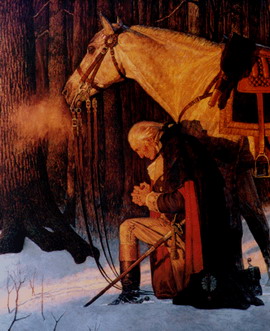
As we begin the final week of our month-long series on the Founding Fathers, Spirituality, and Religion, we turn our attention to George Washington, the commander of the Continental Army during the Revolutionary War, and of course the first President of The United States. A fierce advocate of personal liberties, General Washington worried over the tyranny of establishments and institutions in all matters, especially regarding politics and religion.
As such, Washington belonged to no political party and in fact wished that America would not form parties, not simply out of a fear of tyrrany but also because he felt a party system would encourage conflict and prevent governments from getting things done. Looking at the current sad state of political affairs, we see that Washington’s concerns were very prescient.
The following passage is from a letter dated May 10, 1789, written to the United Baptist Churches in Virginia. Here we find Washington emphasizing that we worship by the dictates of our own consciences, not by the dictates of organized church bodies or religious establishments, which are more than capable of inflicting spiritual tyranny on their congregations. Washington held the belief (common among many of the Founding Fathers) that the individual alone is responsible for his or her relationship to God.
If I could have entertained the slightest apprehension that the Constitution framed in the Convention, where I had the honor to preside, might possibly endanger the religious rights of any ecclesiastical society, certainly I would never have placed my signature to it; and if I could now conceive that the general government might ever be so administered as to render the liberty of conscience insecure, I beg you will be persuaded that no one would be more zealous than myself to establish effectual barriers against the horrors of spiritual tyranny, and every species of religious persecution.
For you, doubtless, remember that I have often expressed my sentiment, that every person, conducting themselves as a good citizen, and being accountable to God alone for their religious opinions, ought to be protected in worshiping the Deity according to the dictates of their own conscience.
—
Read the next article in our series on the Founding Fathers: James Wilson, Religion, & the American Character.
Gain fresh insight into the Lord’s Prayer. Read our free online book The Lord’s Prayer for Daily Life. The prayer’s hidden teachings will enrich and inspire you. Click the following link to begin reading the Living Hour book now: The Lord’s Prayer.