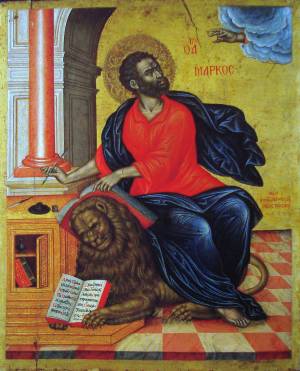
Angel of the Lord
August 4, 2011 by Administrator
Filed under Gospel of Matthew
Gospel of Matthew 2
After the birth of Jesus at Bethlehem in Judea, in the reign of King Herod, some wise men from the east arrived in Jerusalem, asking: 2 “Where is the new–born King of the Jews? For we saw his star in the east, and have come to pay homage to him.”
3 When King Herod heard of this, he was much troubled, and so too was all Jerusalem. 4 He called together all the chief priests and teachers of the law in the nation, and questioned them as to where the Christ was to be born. 5 “At Bethlehem in Judea,” was their answer; “for it is said by the prophet: 6 ‘And Bethlehem in Judah’s land is in no way least among the chief cities of Judah; for out of it will come a chieftain—one who will shepherd my people Israel.’“
7 Then Herod secretly sent for the wise men and ascertained from them the date of the appearance of the star; 8 And, sending them to Bethlehem, he said: “Go and make careful inquiries about the child, and as soon as you have found him, bring me word that I too may go and pay homage to him.”
9 The wise men heard what the king had to say, and then continued their journey. And the star which they had seen in the east led them on, until it reached and stood over the place where the child was. 10 At the sight of the star they were filled with joy. 11 Entering the house, they saw the child with his mother, Mary, and fell at his feet and paid homage to him. Then they unpacked their treasures, and offered to the child presents of gold, frankincense, and myrrh. 12 But afterwards, having been warned in a dream not to go back to Herod, they returned to their own country by another road.
——-
Explore Jesus’s Prayer
——-
13 After they had left, an angel of the Lord appeared to Joseph in a dream, and said: “Awake, take the child and his mother, and seek refuge in Egypt; and stay there until I bid you return, for Herod is about to search for the child, to put him to death.” 14 Joseph awoke and took the child and his mother by night into Egypt, 15 And there he stayed until Herod’s death; in fulfillment of these words of the Lord by the prophet: ‘Out of Egypt I called my Son.’
16 When Herod found that he had been trifled with by the wise men, he was very angry. He sent and put to death all the boys in Bethlehem and the neighboring coasts who were two years old or under, guided by the date which he had ascertained from the wise men.
17 Then were fulfilled these words spoken by the prophet Jeremiah: 18 ‘A voice was heard in Ramah, weeping and much lamentation; Rachel, weeping for her children, refused to be comforted because they were not.’ 19 But, on the death of Herod, an angel of the Lord appeared in a dream to Joseph in Egypt, and said: 20 “Awake, take the child and his mother, and go into the land of Israel, for those who sought to take the child’s life are dead.”
21 And he awoke, and took the child and his mother into the land of Israel. 22 But, hearing that Archelaus had succeeded his father Herod as King of Judea, he was afraid to go back there (having been warned of it in a dream); nevertheless, he went into the part of the country called Galilee. 23 And there he settled in the town of Nazareth, in fulfillment of these words by the prophets: ‘He will be called a Nazarene.’
—-
To read Chapter 19 of the Gospel of Matthew, please go to: Brood of Vipers
Gain fresh insight into the Lord’s Prayer. Read our free online book The Lord’s Prayer for Daily Life. The prayer’s hidden teachings will enrich and inspire you. Click the following link to begin reading the Living Hour Book now: The Lord’s Prayer.
Browse the entire Gospel of Matthew here: Gospel of Matthew
John – Gospel 18 – Christ’s Kingdom Is Now
November 21, 2008 by Administrator
Filed under John
When Jesus had said this, he went out with his disciples and crossed the brook Cedron to a place where there was a garden, into which he and his disciples went. 2 The place was well known to Judas, the betrayer, for Jesus and his disciples had often met there. 3 So Judas (who had obtained soldiers of the Roman garrison, and some officers from the chief priests and Pharisees) came there with lanterns, torches, and weapons. 4 Jesus, aware of all that was coming upon him, went to meet them, and said to them: “For whom are you looking?”
5 “Jesus of Nazareth,” was their answer. “I am he,” said Jesus. (Judas, the betrayer, was also standing with them.) 6 When Jesus said ‘I am he,’ they drew back and fell to the ground. 7 So he again asked for whom they were looking, and they answered: “Jesus of Nazareth.” 8 “I have already told you that I am he,” replied Jesus, “so, if it is for me that you are looking, let these men go.” 9 This was in fulfillment of his words: ‘Of those whom thou has given me I have not lost one.’
10 At this, Simon Peter, who had a sword with him, drew it, and struck the high priest’s servant, and cut off his right ear. The servant’s name was Malchus. 11 But Jesus said to Peter: “Sheathe your sword. Shall I not drink the cup which the Father has given me?” 12 So the soldiers of the garrison, with their captain and the Jewish officers, arrested Jesus and bound him, 13 And took him first of all to Annas. Annas was the father-in- law of Caiaphas, who was high priest that year. 14 It was Caiaphas who had counseled the Jews that it was best that one man should die for the people.
15 Meanwhile Simon Peter followed Jesus, and so did another disciple. That disciple, being well-known to the high priest, went with Jesus into the high priest’s court-yard, 16 While Peter stood outside by the door. Presently the other disciple—the one well-known to the high priest—went out and spoke to the maidservant, and brought Peter in. 17 So the maidservant said to Peter: “Are not you also one of this man’s disciples?” “No, I am not,” he said.
18 The servants and officers were standing round a charcoal fire (which they had made because it was cold), and were warming themselves. Peter, too, was with them, standing and warming himself. 19 The high priest questioned Jesus about his disciples and about his teaching.
20 “For my part,” answered Jesus, “I have spoken to all the world openly. I always taught in some synagogue, or in the temple courts, places where all the Jews assemble, and I never spoke of anything in secret. 21 Why question me? Question those who have listened to me as to what I have spoken about to them. They must know what I said.”
22 When Jesus said this, one of the officers, who was standing near, gave him a blow with his hand. “Do you answer the high priest like that?” he exclaimed. 23 “If I said anything wrong, give evidence about it,” replied Jesus; “but if not, why do you strike me?” 24 Annas sent him bound to Caiaphas the high priest.
25 Meanwhile Simon Peter was standing there, warming himself; so they said to him: “Are not you also one of his disciples?” Peter denied it. “No, I am not,” he said. 26 One of the high priest’s servants, a relation of the man whose ear Peter had cut off, exclaimed: “Did not I myself see you with him in the garden?” 27 Peter again denied it; and at that moment a cock crowed.
28 From Caiaphas they took Jesus to the government house. It was early in the morning. But they did not enter the government house themselves; otherwise they should become ‘defiled,’ and so be unable to eat the Passover. 29 Therefore Pilate came outside to speak to them. “What charge do you bring against this man?” he asked.
30 “If he had not been a criminal, we should not have given him up to you,” they answered. 31 “Take him yourselves,” said Pilate, “and try him by your own law.” “We have no power to put anyone to death,” the Jews replied—32 In fulfillment of what Jesus had said when indicating the death that he was destined to die.
33 After that, Pilate went into the Government House again, and calling Jesus up, asked him: “Are you the King of the Jews?” 34 “Do you ask me that yourself?” replied Jesus, “or did others say it to you about me?” 35 “Do you take me for a Jew?” was Pilate’s answer. “It is your own nation, and the chief priests, who have given you up to me. What have you done?”
36 “My kingdom,” replied Jesus, “is not of this world. If it had been so, my servants would be doing their utmost to prevent my being given up to the Jews; but now is my kingdom, not from hence.”
37 “Are you a king then?” asked Pilate. “You say that I am a king,” answered Jesus. “To this end was I born, and for this cause I came into the world—to bear witness to the truth. Everyone who is on the side of truth listens to my voice.” 38 “What is truth?” asked Pilate.
After saying this, he went out to the Jews again, and said: “For my part, I find nothing with which he can be charged. 39 It is, however, the custom for me to grant you the release of one man at the Passover festival. Do you wish for the release of the King of the Jews?” 40 “No, not this man,” they shouted again, “but Barabbas!” This Barabbas was a robber.
To read the next chapter of the Book of John, please go to The Gospel of John – 19.
This Online New Testament Gospel of John is excerpted from the book The Living Hour: The Lord’s Prayer for Daily Life (with New Century Gospels). Including over 200 bookmarked citations from the canonical Gospels, this Progressive Christian book appeals to the Unitarian spirit at the heart of all faiths.
Challenge your perceptions on the Gospel of Christ, Jesus’s parables, and the Kingdom of God by purchasing The Lord’s Prayer book today. Produced by LivingHour.org, a Thailand-based small press dedicated to publishing unique Learning Easy Thai Language Books, as well as works on progressive spirituality.
John – Gospel 19 – Jesus Carries His Cross
November 18, 2008 by Administrator
Filed under John
After that, Pilate had Jesus scourged. 2 The soldiers made a crown with some thorns, and put it on his head, and threw a purple robe round him. 3 They kept coming up to him and saying: “Long live the King of the Jews!” and they gave him blow after blow with their hands.
4 Pilate again came outside, and said to the people: “Look! I am bringing him out to you, so that you may know that I find nothing with which he can be charged.” 5 Then Jesus came outside, wearing the crown of thorns and the purple robe; and Pilate said to them: “Here is the man!”
6 When the chief priests and the officers saw him, they shouted: “Crucify him! Crucify him!” “Take him yourselves and crucify him,” said Pilate. “For my part, I find nothing with which he can be charged.”
7 “But we,” replied the Jews, “have a law under which he deserves death, for making himself out to be the Son of God.” 8 When Pilate heard what they said, he became still more alarmed; 9 And, going into the government house again, he said to Jesus: “Where do you come from?”
10 But Jesus made no reply. So Pilate said to him: “Do you refuse to speak to me? Do not you know that I have the power to release you, and the power to crucify you?” 11 “You would have no power over me at all,” answered Jesus, “if it had not been given you from above; and, therefore, the man who betrayed me to you is guilty of the greater sin.” 12 This made Pilate anxious to release him; but the Jews shouted: “If you release that man, you are no friend of Caesar! Anyone who makes himself out to be a king is setting himself against the Emperor!”
13 On hearing what they said, Pilate brought Jesus out, and took his seat upon the bench at a place called ‘The Stone Pavement’—in Hebrew ‘Gabbatha.’14 It was the Passover preparation day, and about noon. Then he said to the Jews: “Here is your King!” 15 At that the people shouted: “Kill him! Kill him! Crucify him!”
“What! Shall I crucify your king?” exclaimed Pilate. “We have no king but Caesar,” replied the chief priests; 16 Whereupon Pilate gave Jesus up to them to be crucified. So they took Jesus; 17 And he went out, carrying his cross himself to the place named for a skull, or, in Hebrew, Golgotha.
18 There they crucified him, and two others with him—one on each side, and Jesus between them. 19 Pilate also had these words written, and put up over the cross: ‘JESUS OF NAZARETH, THE KING OF THE JEWS.’ 20 These words were read by many of the Jews, because the place where Jesus was crucified was near the city; and they were written in Hebrew, Latin, and Greek. 21 The Jewish chief priests said to Pilate: “Do not write ‘The King of the Jews’, but write what the man said, ‘I am the King of the Jews.’” 22 But Pilate answered: “What I have written, I have written.”
23 When the soldiers had crucified Jesus, they took his clothes and divided them into four shares—a share for each soldier—and they took the coat also. The coat had no seam, being woven in one piece from top to bottom. 24 So they said to one another: “Do not let us tear it, but let us cast lots for it, to see who shall have it.” This was in fulfillment of the words of scripture: ‘They shared my clothes among them, and over my clothing they cast lots.’ That was what the soldiers did.
25 Meanwhile near the cross of Jesus were standing his mother and his mother’s sister, as well as Mary the wife of Clopas and Mary Magdalene. 26 When Jesus saw his mother, and the disciple whom he loved, standing near, he said to his mother: “There is your son.” 27 Then he said to that disciple: “There is your mother.” And from that very hour the disciple took her to live in his house.
28 Afterwards, knowing that everything was now finished, Jesus said, in fulfillment of the words of scripture: “I am thirsty.” 29 There was a bowl standing there full of common wine; so they put a sponge soaked in the wine on the end of a hyssop-stalk, and held it up to his mouth. 30 When Jesus had received the wine, he exclaimed: “All is finished!” Then, bowing his head, he gave up the ghost.
31 It was the preparation day, and so, to prevent the bodies from remaining on the crosses during the Sabbath (for that Sabbath was a great day), the Jews asked Pilate to have the legs broken and the bodies removed. 32 Accordingly the soldiers came and broke the legs of the first man, and then those of the other who had been crucified with Jesus; 33 But, on coming to him, when they saw that he was already dead, they did not break his legs. 34 One of the soldiers, however, pierced his side with a spear, and blood and water immediately flowed from it.
35 This is the statement of one who actually saw it—and his statement may be relied upon, and he knows that he is speaking the truth—and it is given in order that you also may be convinced. 36 For all this took place in fulfillment of the words of scripture: ‘Not one of its bones shall be broken.’ 37 And there is another passage which says: ‘They will look upon him whom they pierced.’
38 After this, Joseph of Arimathaea, a disciple of Jesus—but a secret one, owing to his fear of the Jews—begged Pilate’s permission to remove the body of Jesus. Pilate gave him leave; so Joseph went and removed the body. 39 Nicodemus, too—the man who had formerly visited Jesus by night—came with a roll of myrrh and aloes, weighing nearly a hundred pounds.
40 They took the body of Jesus, and wound it in linen with the spices, according to the Jewish mode of burial. 41 At the place where Jesus had been crucified there was a garden, and in the garden a newly-made tomb in which no one had ever been laid. 42 And so, because of its being the preparation day, and as the tomb was close at hand, they laid Jesus there.
To read the next chapter in the Book of John, please go to The Gospel of John – 20.
Excerpted from the book The Living Hour: The Lord’s Prayer for Daily Life (with New Testament Gospels). A faith book especially suited for Progressive Christianity workshops, Bible Study Groups, Unitarian Christians, and all who seek a richer life.
Challenge your perceptions on the Gospel of Christ, Jesus’s parables, and the Kingdom of God by purchasing The Lord’s Prayer book today. Produced by LivingHour.org, a Thailand-based small press dedicated to publishing unique Learning Easy Thai Language Books, as well as works on progressive spirituality.
King of the Jews
November 14, 2008 by Administrator
Filed under Gospel of Mark
Gospel of Mark 15
As soon as it was daylight, the chief priests, after holding a consultation with the councilors and teachers of the law—that is to say, the whole high council—put Jesus in chains and took him away, and gave him up to Pilate.
2 “Are you the King of the Jews?” asked Pilate. “That is what you say,” replied Jesus. 3 Then the chief priests brought a number of charges against him; 4 Upon which Pilate questioned Jesus again. “Have you no reply to make?” he asked. “Listen, how many charges they are bringing against you.” 5 But Jesus still made no reply whatsoever; at which Pilate was astonished.
6 Now, at the feast, Pilate used to grant the people the release of any one prisoner whom they might ask for. 7 A man called Barabbas was in prison with rioters who had committed murder during a riot. 8 So, when the crowd went up and began to ask Pilate to follow his usual custom, 9 He asked: “Do you want me to release the ‘King of the Jews‘ for you?”10 For he was aware that it was out of jealousy that the chief priests had given Jesus up to him.
11 But the chief priests incited the crowd to get Barabbas released instead. 12 Pilate, however, spoke to them again: “What shall I do then with the man whom you call the ‘King of the Jews‘?” 13 Again they shouted: “Crucify him!” 14 “Why, what harm has he done?” Pilate kept saying to them. But they shouted furiously: “Crucify him!” 15 And Pilate, wishing to satisfy the crowd, released Barabbas to them, and after scourging Jesus, gave him up to be crucified.
16 The soldiers then took Jesus away into the court-yard—that is the government house—and they called the whole garrison together. 17 They dressed him in a purple robe and, having twisted a crown of thorns, put it on him, 18 And then began to salute him. “Long life to you, King of the Jews!” they said. 19 And they kept striking him on the head with a rod, spitting at him, and bowing to the ground before him, going down on their knees; 20 And, when they had left off mocking him, they took off the purple robe, and put his own clothes on him.
21 And they led Jesus out to crucify him; and they compelled a passer-by, Simon from Cyrene, who was on his way in from the country, the father of Alexander and Rufus, to go with them to carry his cross. 22 They brought Jesus to the place which was known as Golgotha—a name which means ‘Place of a Skull.’ 23 There they offered him drugged wine; but Jesus refused it. 24 Then they crucified him, and divided his clothes among them, casting lots for them to settle what each should take.
Do You Understand the Lord’s Prayer?
To continue reading Chapter 15 of the Gospel of Mark, please click on page 2 below.