
Prayer & The Oracle of Jesus

August 13, 2009 by Administrator  
Filed under Motivationals

ethan-allen-religion Prayer & The Oracle of JesusIn this final installment of our special series on the Founding Fathers and their thoughts on God, Religion, & the Divine, we move to farmer, politician, and guerilla revolutionary leader Ethan Allen, who perhaps is best known for leading the Green Mountain Boys (and other fighters) in their raid and capture Fort Ticonderoga, a strategic victory which severely hampered communication between the northern and southern units of the British army.

Like Thomas Jefferson and Benjamin Franklin, Ethan Allen might be best described as a Progressive Christian Deist who believed reason must take a paramount place in religious activity. The following passage is taken from Section IV of Ethan Allen’s book, Reason: The Only Oracle of Man (1784), and deals with the subject of prayer. In synch with the philosophy of prayer that guides our free book The Living Hour: The Lord’s Prayer for Daily, Allen writes:

Whoever has a just sense of the absolute perfection of God, and of their own imperfection, and natural subjection to his providence, cannot but from thence infer the impropriety of praying or supplicating to God, for this, that, or the other thing; or of remonstrating against his providence: inasmuch, as “known to God are all our wants;” and as we know, that we ourselves are inadequate judges of what would be best for us, all things considered.

To pray for any thing, which we can obtain by the due application of our natural powers, and neglect the means of procuring it, is impertinence and laziness in the abstract; and to pray for that which God in the course of his providence, has put out of our power to obtain, is only murmuring against God, and finding fault with his providence, or acting the inconsiderate part of a child; for example, to pray for more wisdom, understanding, grace or faith; for a more robust constitution, handsomer figure, or more of a gigantic size, would be the same as tolling God, that we are dissatisfied with our inferiority in the order of being; that neither our souls nor bodies suit us; that he has been too sparing of his beneficence; that we want more wisdom, and organs better fitted for show, agility and superiority.

But we ought to consider, that “we cannot add one Cubit to our stature,” or alter the construction of our organic frame; and that our mental talents are finite; and that in a vast variety of proportions and disproportions, as our Heavenly Father in his order of nature, and scale of being saw fit; who has nevertheless for the encouragement of intelligent nature ordained, that it shall be capable of improvement, and consequently of enlargement; therefore, “whosoever lacketh wisdom,” instead of “asking it of God,” let him improve what he has, that he may enlarge the original stock; this is all the possible way of gaining in wisdom and knowledge, a competency of which will regulate our faith. But it is too common for great faith and little knowledge to unite in the same person; such persons are beyond the reach of argument and their faith immovable, though it cannot remove mountains.

The only way to procure food, raiment, or the necessaries or conveniences of life, is by natural means; we do not get them by wishing or praying for, but by actual exertion; and the only way to obtain virtue or morality is to practice and habituate ourselves to it, and not to pray to God for it: he has naturally furnished us with talents or faculties suitable for the exercise and enjoyment of religion, and it is our business to improve them aright, or we must suffer the consequences of it. We should conform ourselves to reason, the path of mortal rectitude, and in so doing, we cannot fail of recommending ourselves to God, and to our own consciences. This is all the religion which reason knows or can ever approve of.

If you appreciate the work of LivingHour.org, please support us today by linking to our website. We also welcome your financial support. You can make your secure online donation via PayPal by clicking the following icon:

pixel Prayer & The Oracle of Jesus


The Living Hour’s SBNR motivational series combines history, literature, philosophy, psychology, and religion to help bring about new perspectives on Progressive Christianity and spirituality. Sign up by entering your email address into the “Opening the Small Gate” box in the right corner of this web page.

Thomas Jefferson on Jesus, Religion & Reason
July 27, 2009 by Administrator  
Filed under Motivationals

Comments Off

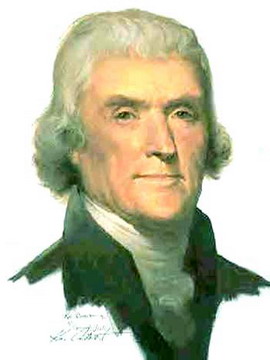
jefferson_religion_jesus Thomas Jefferson on Jesus, Religion & Reason This week in our special series on the Founding Fathers, we return to Thomas Jefferson, who likely wrote more on the subjects of God, Christianity, and Religion than any of the other Americans we attribute “founding father” status. Indeed Jefferson went so far as to famously write The Jefferson Bible, or The Life and Morals of Jesus of Nazareth, in an attempt to clear up many of the misconceptions he felt surrounded the Nazarene and were being promulgated by the Church. As such, Thomas Jefferson might genuinely be considered the Father of SBNR (Spiritual But Not Religious) Progressive Christianity in America.

The following passage is not taken from The Jefferson Bible, but rather a letter written to a young man named Peter Carr, studying in Paris. In this letter (dated Aug. 10, 1787) Jefferson offers his advice on Carr’s ongoing education, and in the excerpt below, on the subjects of religion, reason, and the person known as Jesus of Nazareth.

Religion. Your reason is now mature enough to examine this object. First thing, rid yourself of all bias that favors novelty and singularity of opinion. Indulge them in any other subject except that of religion. It is too important, and the consequences of error may be too serious. On the other hand, shake off all the fears and servile prejudices under which weak minds are submissively crouched. Fix reason firmly in her seat, and call to her tribunal every fact, every opinion. Question with boldness even the existence of a god; because, if there be one, he must more approve of a homage of reason than that of blindfolded fear.

You will naturally want to examine first the religion of your own country. Read the old testament bible then, as you would read the books of the great philosophers. The facts which are within the ordinary course of nature you will believe on the authority of the writer, as you would with the writers of other great works. The testimony of the writer weighs in their favor when the laws of nature do not contradict them. But those facts in the bible which contradict the laws of nature must be examined with more care, and under a variety of perspectives.

You will next want to read the new testament. It is the history of a personage called Jesus. Keep in your eye the pretensions of those who say he was begotten by God, born of a virgin, suspended and reversed the laws of nature at will, and ascended bodily into heaven: and of those who say he was a man of illegitimate birth, of a benevolent heart, enthusiastic mind, who set out without pretensions to divinity, ended up believing them, and was punished capitally for sedition by being crucified according to the Roman law.

Regarding books that discuss these matters, keep your reason firmly on the watch when reading them all. Do not be frightened from your inquiry by any fear of it’s consequences. If it ends in a belief that there is no God, you will still find incitements to virtue and the love of others. If you find reason to believe there is a God, a consciousness that you are acting under his eye, and that he approves you, will be a vast additional incitement; for if there be a future state, the hope of a happy existence in that increases the appetite to deserve it. And if it turns out that you believe Jesus was also a God, you will be comforted by a belief in his aid and love.

But I repeat that you must lay aside all prejudice on both sides, and neither believe nor reject anything because any other people or institutions have rejected or believed it. Your own reason is the only oracle given you by heaven, and you are answerable not for the rightness but uprightness of your decisions.1

If you appreciate the work of LivingHour.org, please support us today by linking to our website. We also welcome your financial support. You can make your secure online donation via PayPal by clicking the following icon:

pixel Thomas Jefferson on Jesus, Religion & Reason


The Living Hour’s SBNR motivational series combines history, literature, philosophy, psychology, and religion to help bring about new perspectives on Progressive Christianity and spirituality. Sign up by entering your email address into the “Opening the Small Gate” box in the right corner of this web page.

  1. The above passage by Jefferson was slightly edited to make it easier to read by the modern reader []

The Founding Fathers On Christianity, God, & Religion

July 13, 2009 by Administrator  
Filed under Motivationals

Comments Off

founding-fathers-god-religion The Founding Fathers On Christianity, God, & Religion Many of the Founding Fathers of the United States could be best described as SBNR (Spiritual But Not Religious) Progressive Christians. We at The Living Hour often look back to them for inspiration, for they were leaders who possessed a solid sense of reason that was backed by an understanding of the divine nature of creation and their place in it. As such, they strongly demonstrated all the characteristics of the truly progressive Christian.

Therefore for the next month, our SBNR Motivational series will be featuring passages from Thomas Jefferson, Benjamin Franklin, Thomas Paine, John Adams, and other early Americans, on the subjects of Christianity, God, and Religion. To get the ball rolling, let’s begin with the following passage from Thomas Jefferson, taken from a letter to Moses Robinson, the governor of the Vermont Republic who helped usher Vermont to statehood.

In this passage we find Jefferson commenting on the Christian clergy, the Church, and the State, comments which still are very relevant today. Jefferson’s hope that “good sense” will prevail among orthodox Christians is unfortunately still waiting to be realized:

The Eastern States will be the last to come over, because of the dominion of the clergy, who had got a smell of union between Church and State, and began to indulge in reveries that can never be realized in the age of science. If, indeed, they could have prevailed on us to view all the advances in science as dangerous innovations, and to look back to the opinions and practices of our forefathers, instead of looking forward, for improvement, a promising groundwork would have been laid.

But I have hopes that their good sense will show them that since the mountain will not come to them, they had better go to the mountain: that they will find it in their interest to acquiesce to the liberty and science of their country, and that the Christian religion, when divested of the rags in which they have enveloped it, and brought to the original purity and simplicity of its benevolent institutor, is a religion most friendly to liberty, science, and the freest expansion of the human mind.

I sincerely wish with you, we could see our government so secured as to depend less on the character of the person in whose hands it is trusted. Bad men will sometimes get in, and with such an immense patronage, may make great progress in corrupting the public mind and principles. This is a subject with which wisdom and patriotism should be occupied.1

The Living Hour’s SBNR motivational series combines history, literature, philosophy, psychology, and religion to help bring about new perspectives on Progressive Christianity and spirituality. Sign up by entering your email address into the “Opening the Small Gate” box in the right corner of this web page.

lords_prayer_book The Founding Fathers On Christianity, God, & Religion

  1. Some very small edits were made to above passage to make the reading easier for the contemporary reader []