
20 Jul Thomas Paine on Christianity & True Greatness
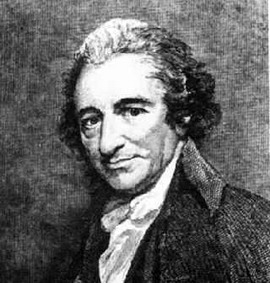 Founding Fathers Religion, we begin with the revolutionary Thomas Paine, a statesman who often was ostracized for his SBNR (Spiritual But Not Religious) views on Christianity, God, and religion. Like a true Progressive Christian, Paine tried to encourage forward progress in all aspects of the individual life and the life of the nation. His work “The Rights of Man” remains a testament to his enlightened perspective on the nature of public rights versus those of a government, while his famous pamphlet “Common Sense” reminds us still today, to our chagrin, how uncommon “common sense” truly is.
The following passage comes from “To The People of England” included in The Writings of Thomas Paine, Volume I. Here we find Paine discussing one of his favorite topics, national honor, from the simple perspective of common decency. As is so often the case with the writings of the Founding Fathers, Paine’s commentary remains as relevant today as when it was written:
There is an idea that exists in the world known as national honor, and this, falsely understood, is often times the cause of war. In a Christian and philosophical sense, mankind seems to have stood still at individual civilization, and to retain as nations all the original rudeness of nature. Peace by treaty is only a cessation of violence for a reformation of sentiment. It is a substitute for a principle that is wanting and ever will be wanting till the idea of national honor be rightly understood. As individuals we profess ourselves Christians, but as nations we are heathens, Romans, and what not.
I remember the late admiral Saunders declaring in the House of Commons, and that in the time of peace, “That the city of Madrid laid to ashes was not a sufficient atonement for the Spaniards taking off the rudder of an English sloop of war.” I do not ask whether this is Christianity or morality, I ask whether it is decency? Whether it is proper language for a nation to use? In private life we call it by the plain name of bullying, and the elevation of rank cannot alter its character. It is, I think, exceedingly easy to define what ought to be understood by national honor, and that is this:
What is the best character for an individual is the best character for a nation; and wherever the latter exceeds or falls beneath the former, there is a departure from the line of true greatness.1
—-
Read the next article in our series on the Founding Fathers: Patrick Henry & The Christian Divide.
- Some small edits were made in the above passage from Thomas Paine to make it easier to read by modern readers. [↩]