
06 Aug James Wilson & The American Character
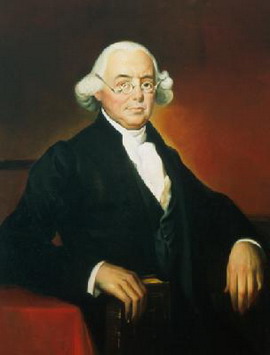 One of our relatively forgotten Founding Fathers is James Wilson, a signatory of The Declaration of Independence, a member of the Continental Congress, and among the first six Supreme Court justices chosen by President George Washington. One the most prominent lawyers of his time, Wilson is often credited as being the most learned of the Framers of the Constitution.
James Wilson was also someone who fretted over the youth of America and strongly advocated teaching young children the principles of liberty, freedom, and justice which inspired the American Revolution. Wilson takes on the teacher’s role in the following passage (from Of the Study of the Law in the United States), where we find him touching on the topic of the American character and how both the law and religion can degenerate into ridiculousness when in the hands of their “injudicious friends” who today many would say have become the majority.
Were I called upon for my reasons why I deem so highly of the American character, I would assign them in a very few words—that is, that the American character has been eminently distinguished by the love of liberty, and the love of law. The science of law should, in some measure, and in some degree, be the study of every free citizen, and of every free person. Every free citizen and every free person has duties to perform and rights to claim. Unless, in some measure, and in some degree, you know those duties and those rights, you can never act a just and an independent part.
Happily, the general and most important principles of law are not removed to a very great distance from common apprehension. It has been said of religion that though the elephant may swim in it, the lamb may wade there too. Concerning law, the same observation may be made. The home navigation, carried on along the shores, is more necessary, and more useful too, than that which is pursued through the deep and expanded ocean.
You have heard much concerning the forms of process, and proceedings, and pleadings. Much has been written in praise, and much has been written in ridicule, of this part of law learning. It has certainly been abused: in some hands, it has become, and daily does become ridiculous. And what is there that has been exempted from a similar fate! Religion herself, elegant and simple as she is, assumes yet an awkward and ridiculous appearance when dressed in the tawdry or tattered robes put upon her by the false taste of her injudicious friends.1
- The above quote by James Wilson has been lightly edited for brevity and ease of reading. [↩]